


You pull up to your vacant Columbus rental and see lights on inside. A strange car sits in the driveway. Nobody is supposed to be there, and stories about squatters rights in Georgia start racing through your head.
Here is the plain-English truth. Georgia does not hand your house to someone after a short stay. But you also cannot kick the door in and drag people out.
This guide covers what squatting means, how Georgia law treats it, and what to do right away. You will also learn how to prevent it and when selling as-is might make more sense.
- Who this helps: landlords, heirs, and out-of-town owners with vacant property around Columbus and East Alabama.
- What it covers: trespass versus tenancy, adverse possession, HB 1017, removal steps, and prevention.
- What it is not: legal advice. I am a local buyer and landlord, not a lawyer.
What Squatters Rights in Georgia Really Mean
A neighbor warns you that someone may have been staying at your vacant house for weeks. Your stomach drops. Before panic sets in, it helps to know what people actually mean by a squatter.
In everyday talk, a squatter is someone living in a property without the owner’s permission or a valid lease. Around Columbus, that label covers several very different situations.
- A stranger who broke into a long-empty inherited house.
- A former tenant who stopped paying rent but never moved out.
- A tenant’s relative or partner who stayed after the renter left.
- A person who “rented” your home from a scammer using fake paperwork.
When people say “squatters rights,” they usually blend two separate ideas. One is due process, meaning the legal steps required to remove someone. The other is adverse possession, a long-term doctrine for claiming ownership.
• Due process protects occupants from being forced out without proper legal steps.
• Adverse possession requires decades of open, owner-like possession before anyone can claim title.
• Viral videos claiming instant ownership do not reflect how Georgia law works.
For most Columbus owners, the real task is removing someone lawfully, not saving the deed. The fear is real, but the law is far more grounded than the horror stories.
Three quick questions help you size up the situation before calling anyone.
- Did this person ever have permission, a lease, or a rent arrangement with you?
- When did you last visit, and when did neighbors first notice activity?
- Is there visible forced entry, such as broken windows or damaged locks?
Georgia Law Basics: Trespassers, Tenants, and Adverse Possession
Picture yourself at a Muscogee County courthouse window. The clerk asks whether the occupant is a tenant or a trespasser. Your answer shapes everything that happens next.
Georgia generally treats trespass as a criminal matter and tenancy disputes as civil matters. The Georgia Landlord-Tenant Handbook explains how the state defines tenants and squatters.
| Occupant type | Typical example | Usual path |
| Trespasser | Stranger who broke into a vacant house | Police and criminal trespass process |
| Current or former tenant | Renter who stopped paying | Civil dispossessory (eviction) case |
| Guest without paperwork | Cousin who stayed after the tenant left | Often treated like a tenant; may need court |
| Long-term occupant | Relative living there for years on a handshake | Complex status; talk to an attorney |
These categories can blur in real life. A cousin who once paid rent may look more like a tenant than a trespasser.
- Written leases make an occupant’s status clearer to police and judges.
- Rent payments, even informal ones, can suggest a tenancy existed.
- A clear break-in with no prior relationship points toward trespass.
Landlords who manage subsidized units face extra paperwork during disputes. Our guide to running a Section 8 rental in Columbus, GA covers those obligations. When in doubt about status, a Georgia attorney can help you label the situation correctly.
- Keep copies of every lease, text, and receipt in one folder.
- Note dates whenever you give someone permission to stay.
- Never let a “short visit” drift into months without a written agreement.
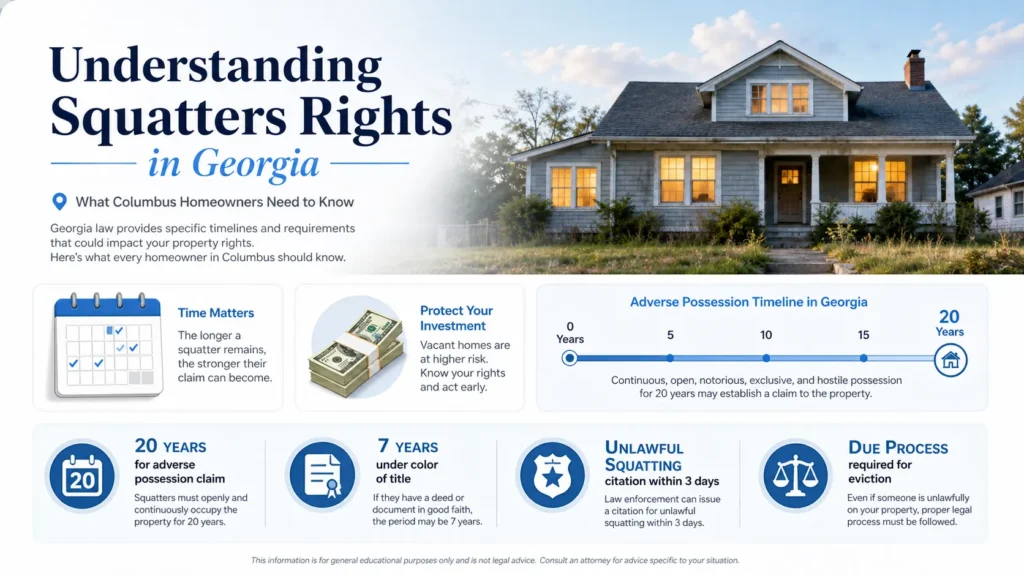
How Long Does It Take to Gain Squatters Rights in Georgia?
A landlord scrolls social media late at night and sees a clip about squatters owning homes quickly. Suddenly they are counting days on the calendar. Georgia’s actual timeline should calm that worry.
Georgia courts generally require 20 years of continuous adverse possession before someone gains prescriptive title. That possession must be public, continuous, exclusive, uninterrupted, and peaceable.
| Claim type | Time required | Key condition |
| Standard adverse possession | 20 years | Public, continuous, exclusive, peaceable possession under claim of right |
| Possession under color of title | 7 years | Written evidence of title, not knowingly forged or fraudulent |
| Permissive occupancy | No clock runs | Possession with permission cannot ripen into title without notice |
The shorter period applies only with written title documents. Georgia’s statute on adverse possession under color of title bars claims based on known forgery or fraud.
- A squatter staying weeks or months comes nowhere close to these standards.
- Paying property taxes and acting quickly strengthens your position as owner.
- Permission given to a guest generally stops the adverse possession clock.
Short-term squatters still cause real damage, lost rent, and court costs. But they do not inherit your house. If someone has lived in a family property for many years, talk with a Georgia attorney promptly.
Watch for these warning signs that a long-term claim could someday surface.
- A relative has lived in the home for years without any written agreement.
- Someone else has been paying the property taxes or insurance.
- A neighbor has fenced or used part of your land for a long time.
- You have not visited or inspected the property in several years.
HB 1017: Georgia’s Squatter Reform Act
You might remember Atlanta news coverage about homeowners fighting squatters for months. Georgia lawmakers responded with new legislation in 2024. Here is what owners should know.
The Georgia Squatter Reform Act (HB 1017) created the offense of unlawful squatting. It passed with unanimous bipartisan support in both chambers.
• Unlawful squatting: entering and residing on property without the owner’s knowledge or consent.
• Citation process: officers can cite suspected squatters, who must show valid documents within three business days.
• No valid documents: the occupant may face arrest and criminal penalties.
• Disputed documents: a magistrate hearing determines whether paperwork is real or fraudulent.
• Fake leases: fraudulent documents can bring added penalties for the occupant.
For Columbus owners, this gives police clearer tools in obvious bad-faith cases. It does not erase due process for people with a genuine lease or tenancy history.
- Clear break-ins may now be handled faster as criminal matters.
- Former tenants still generally go through the dispossessory process.
- Local enforcement can vary, so confirm current procedures with officials.
Laws can change between sessions, so verify current rules before acting. A Georgia attorney or official court resource beats any news headline.
- Ask the responding officer whether they will issue an HB 1017 citation.
- Request a report number and the officer’s name for your records.
- Follow up with the magistrate court if documents are disputed.
What to Do if You Find a Squatter in Your Columbus Property
You sit in your car outside your house. The curtains are drawn and a TV is playing inside. Part of you wants to pound on the door, but a calmer approach works better.
| Step | Action | Why it matters |
| 1 | Stay safe and avoid confrontation | You do not know who is inside |
| 2 | Identify the occupant type | It decides police versus court |
| 3 | Gather ownership and lease records | Proof speeds up official action |
| 4 | Call local law enforcement | Officers may act under HB 1017 |
| 5 | File a dispossessory case if needed | Required for tenants and some guests |
| 6 | Secure the property after removal | Prevents a repeat incident |
Before calling anyone, pull together documents that prove your side. Clear records help both officers and judges move faster.
- A deed, tax bill, or closing statement proving ownership.
- Any leases or written agreements, even expired ones.
- Texts, emails, or rent records showing payments and permission.
- Dated photos of the property, damage, and piled-up mail.
- A timeline of when the last tenant left and activity began.
If the occupant has tenant status, expect a dispossessory case in magistrate court. That usually means a written demand, a filing, service, a hearing, and a writ of possession.
- Make a written demand for possession before filing.
- File the dispossessory affidavit in the county where the property sits.
- Attend the hearing with your records and timeline organized.
Whatever happens, avoid self-help eviction tactics. Changing locks, cutting utilities, or removing belongings can backfire badly in court.
- Self-help moves can hand the occupant arguments against you.
- They can delay your case or expose you to civil claims.
- Proper court orders let law enforcement back you with real authority.
If tax bills are piling up during a long removal, see our guide for owners behind on Muscogee County property taxes. Across the river, Alabama law applies, so keep Georgia and Alabama paperwork separate.

How to Prevent Squatters Around Columbus and East Alabama
You drive past your vacant inherited house and notice an overgrown yard and flyers stacked on the porch. It looks like nobody cares. That neglected look is exactly what attracts trouble.
Some properties face higher risk than others around Columbus and East Alabama.
- Inherited homes sitting empty while families decide what to do.
- Rentals between tenants, especially in rougher neighborhoods.
- Houses owned by out-of-state landlords who rarely visit.
- Stalled renovation projects that sit untouched for months.
| Prevention area | Simple actions |
| Locks and hardware | Sturdy deadbolts, working window locks, rekey after every move-out |
| Lighting and visibility | Motion lights, trimmed bushes, visible entrances from the street |
| Cameras and signs | Doorbell cameras, no-trespassing signs, alarm stickers |
| Upkeep | Regular mowing, mail cleared, broken windows repaired quickly |
| Local eyes | Neighbor or manager visits with photos texted after each check |
| Paperwork | Written leases with dates, tracked keys, no handshake stays |
Turnover is the riskiest window. Re-secure the unit the same day a tenant leaves whenever possible.
Out-of-town owners need a reliable local partner. A trusted neighbor or property manager can spot trouble early.
- Change locks and check every entry point immediately.
- Remove leftover belongings so the house does not look abandoned.
- Schedule regular drive-bys during long vacancies.
Prevention gets harder when you are stretched thin. If upkeep feels impossible, read our guide for owners who can’t keep up with their house anymore in Columbus.
When Fighting Squatters Is Not Worth It: Selling As-Is in Columbus
It is late, and you are staring at court papers, contractor bids, and overdue tax notices. This house has seen an eviction, two break-ins, and now another occupant. You wonder whether it is time to let go.
Many local owners reach that point. Keeping the property may stop making sense in several common situations.
- Repeat trespassing where every vacancy brings a fresh headache.
- Code violations and fines stacking up faster than repairs.
- Major repairs on top of court costs and lost rent.
- Living out of state with no reliable local help.
- An inherited property nobody in the family wants to manage.
Selling as-is to a local cash buyer can bring real relief. You skip repairs, cleanouts, and lender delays. The buyer accounts for the occupant situation in the offer.
- No repairs or upgrades before closing.
- No deep cleaning or full cleanout required.
- The buyer takes on the occupant risk and legal process.
When comparing options, look beyond the sale price alone. Understanding the true cost of selling a house in Georgia helps you compare a listing against a cash offer.
- Count lost rent and extra mortgage payments.
- Add travel costs and time off work for court dates.
- Include security, cleanup, and repair bills after each incident.
Before accepting any offer, ask a few direct questions. A reputable buyer will answer them clearly and without pressure.
- Will you buy the house with the occupant still inside?
- Who handles the removal process and its costs after closing?
- Which closing attorney or title company will you use?
- How quickly can you close, and is the offer firm?
Own a rough house across the river too? Our guide to selling a Phenix City house in poor condition covers Alabama options. Confirm disclosure and closing rules with a Georgia attorney or closing professional.
FAQs: Squatters Rights in Georgia
Can a squatter ever own my Georgia property?
Only in rare cases. Georgia generally requires 20 years of public, continuous, exclusive, peaceable possession, or seven years under color of title. Short-term squatters never come close, especially when owners pay taxes and act promptly.
Can I evict a squatter in Georgia without going to court?
Sometimes. Under HB 1017, police can cite obvious squatters who lack valid documents. Former tenants or occupants with real paperwork usually require a dispossessory case. Confirm your situation with a Georgia attorney.
What should I do first if I find a squatter?
Stay safe and avoid confronting anyone. Photograph the property, gather ownership records, and note who might be inside. Then contact local law enforcement or a Georgia landlord-tenant attorney for guidance.
Can I change the locks or cut utilities to force squatters out?
No. Self-help tactics like changing locks, cutting utilities, or removing belongings are risky in Georgia. They can delay your case and expose you to legal claims. Use police or court processes instead.
Can I sell a Georgia property with a squatter still inside?
Yes. Some local cash buyers purchase occupied houses as-is when everyone is honest about the situation. The buyer typically takes on the removal process. Confirm disclosure requirements with a Georgia attorney or closing professional.
Will squatters scare off a cash buyer in Columbus?
Not usually. Investors who buy as-is houses in Columbus expect occupancy and legal headaches. Squatters may lower the offer, but they rarely make a house unsellable. A direct conversation clarifies your options.
If squatters, break-ins, or a draining vacant property are wearing you down, you have options. You can follow the legal process with a good attorney, or sell as-is to a local cash buyer serving Columbus, GA and East Alabama. Either way, Georgia law gives you a clear path forward.