


You have a buyer lined up for your Columbus house, or you need to sell fast. Then the closing attorney calls about a cloud on your title, and everything stops. Suddenly, a quiet title action is on the table, and the whole deal feels shaky.
This guide explains what a quiet title action in Georgia means, when it comes up, and how it affects timing for Columbus sellers. It also covers your options if you simply want a clean, as-is exit.
This article is information only, not legal advice. Only a Georgia real estate or probate attorney can tell you whether a quiet title case fits your situation.
In this guide, you will learn:
- What a cloud on title is and when it becomes serious.
- How Georgia’s quiet title process, including the Special Master, usually works.
- What drives cost, timing, and risk for Columbus sellers.
- How selling as-is to a local cash buyer compares with clearing title first.
What Is a Quiet Title Action in Georgia?
A quiet title action is a lawsuit asking a judge to decide who truly owns a property. It removes serious title problems that scare off buyers, lenders, and title companies. Cornell Law School’s Legal Information Institute describes it as a special proceeding to determine ownership of real property.
In Georgia, the statutory version is often called a petition to quiet title “against all the world.” The court order is recorded, so future buyers can see who holds clear title. As Investopedia explains, winning such a case typically makes the title insurable and marketable again.
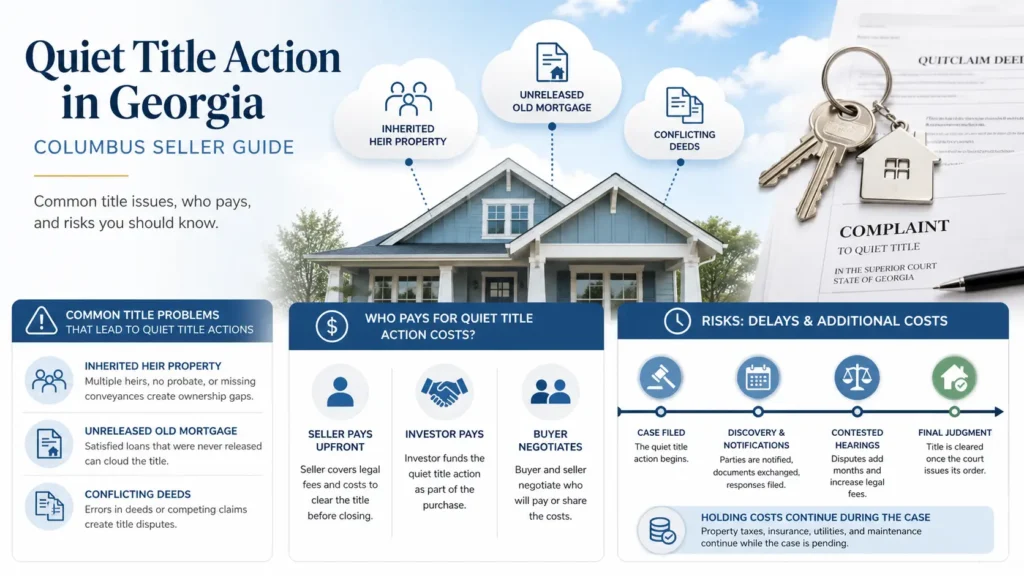
A cloud on title is any question mark in the records that makes people doubt you can sell or mortgage. Around Columbus, common clouds include:
- An old mortgage that was paid off but never cancelled in county records.
- A deceased owner whose estate never went through probate.
- Two conflicting deeds, each naming a different buyer.
- A past tax sale where a former owner or lienholder may still claim rights.
Picture an inherited Columbus house where three siblings each believe they own a share. Mom’s name is still on the deed, and probate never happened. A buyer’s title company may refuse to insure because nobody clearly has authority to sell.
Smaller problems often need only simple curative steps. These include recording a missing deed, getting a lien release, or correcting a typo in a legal description.
Quiet title is usually reserved for problems so serious that a title company will not insure the sale. If one document can fix it, you likely do not need a lawsuit.
Common Georgia Title Problems That Lead to a Quiet Title Case
People start discussing quiet title when one extra form will not satisfy the title company. The table below shows how common Columbus title issues usually play out.
| Title problem | Possible simple fix | When quiet title may come up |
| Inherited heir property, no probate | Complete probate properly | Missing heirs or disputes over who can sign |
| House bought at a tax sale | Redemption paperwork or releases | Former owners may still claim rights |
| Unreleased old mortgage or security deed | Lender cancellation or release | Lender cannot be found or refuses |
| Conflicting deeds in the chain of title | Corrective deed | Two parties both claim ownership |
| Boundary or encroachment dispute | Survey and neighbor agreement | Neighbors cannot agree on the line |
Heir property is especially common across Georgia. The Georgia Heirs Property Law Center helps families clear fractured title when owners die without a will.
Tax trouble can also create title headaches over time. If you are behind on Muscogee County property taxes, act early before a tax sale adds another cloud.
Ask your attorney or title company a few direct questions:
- Can one corrective document solve this, or will the title company insist on a court order?
- Is probate the real issue rather than a true ownership dispute?
- Are there heirs or lienholders who cannot be located?
- Will a buyer’s lender accept the title once the issue is resolved?
- Roughly how long would each option take in Muscogee County?
The answers help you decide between a quick curative fix and a full court case. They also help a buyer judge how much time the sale may realistically need.
How a Quiet Title Action in Georgia Usually Works
A Georgia quiet title action moves through several stages, from title research to a recorded court order. Details vary by county and case, so treat this as a road map for attorney conversations.
Georgia’s Quiet Title Act requires the court to appoint a Special Master. The Supreme Court of Georgia has confirmed this appointment is mandatory under the statute. The Special Master reviews evidence and reports findings to the judge, who issues the final decree.
Typical steps include:
1. Attorney consultation. You explain the title problem and your goal, such as selling or refinancing.
2. Title review. The attorney examines deeds, tax sales, liens, and probate history.
3. Petition filed. The attorney files a petition describing the property and the clouds to remove.
4. Special Master appointed. A neutral attorney determines who must receive notice.
5. Notice to claimants. Heirs, prior owners, and lienholders are served or notified by publication.
6. Hearing. Evidence is reviewed, and anyone contesting the claim can respond.
7. Final order recorded. The judge issues a decree, which is recorded in the property records.
Before your first meeting, gather these documents:
- Any deeds, including warranty, quitclaim, or tax deeds.
- Tax sale notices and prior title reports or closing packages.
- Wills, letters of administration, and death certificates.
- Loan payoff letters and lien release letters.
Bringing an organized stack of papers saves attorney time and often lowers your bill. It also helps the attorney spot simpler fixes before recommending a lawsuit.
Filing without a Georgia attorney is risky because procedural mistakes can undo the case. Courts have voided quiet title judgments when notice or Special Master rules were not followed.
A local buyer cannot replace your attorney, but they can stay with the deal while legal work moves forward. That may mean agreeing on price and timeline now, then closing after the court order.
What a Quiet Title Action Might Cost in Georgia (and Who Pays)
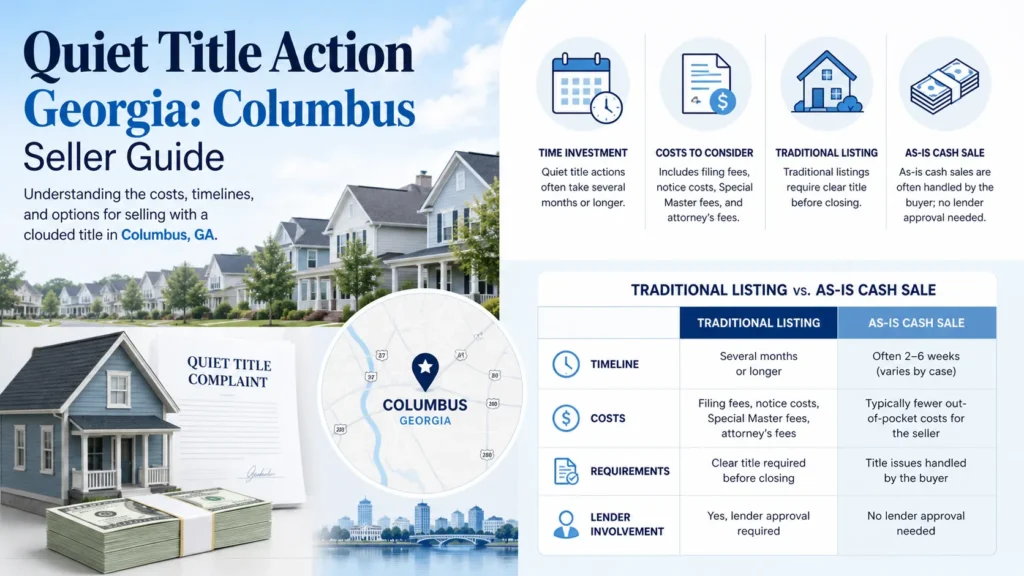
Quiet title actions cost real money, but exact Georgia figures were not verified for this article. Total cost depends on title complexity, the number of people notified, and whether anyone fights.
Common cost components include:
• Court filing fees to open and maintain the case.
• Service and publication costs for notifying possible claimants.
• Special Master fees for reviewing evidence and preparing a report.
• Attorney’s fees for research, filings, and hearings.
An uncontested case usually costs far less than a contested heir property dispute. Many heirs, missing relatives, or an aggressive former owner can multiply hearings and legal hours. Always request a written fee estimate from a Georgia attorney before committing.
Who pays often depends on your plan for the property:
| Sale path | Who usually pays | Main trade-off |
| Clear title, then list traditionally | Seller pays upfront | Higher price, but months of holding costs |
| Tax deed investor clears title | Investor pays | Part of the investment’s cost basis |
| Sell as-is to a local cash buyer | Negotiated, often buyer | Lower price, less hassle and risk |
The key idea is net proceeds, meaning what you actually keep after every expense. Review how much it costs to sell a house in Georgia before comparing offers.
A slightly lower cash offer can sometimes leave a similar amount in your pocket. That happens when the buyer absorbs legal costs, repairs, and months of holding expenses.
When comparing offers, list every expense you would carry under each option:
- Attorney’s fees and court costs for clearing title.
- Monthly taxes, insurance, and utilities while the case is pending.
- Repairs a traditional buyer’s inspector would likely flag.
- Agent commissions and seller closing costs.
Timeline, Who Can File, and Key Risks
Quiet title actions are lawsuits, so they often take several months or longer. Exact Georgia timelines were not verified, so ask a local attorney about recent Muscogee County cases.
Factors that affect timing include:
- How busy the county court is.
- How long it takes to locate and notify every possible claimant.
- Whether anyone files an objection.
- How quickly the Special Master completes the review.
While the case is pending, you still pay taxes, insurance, and utilities, and vacant homes face vandalism. A local buyer can add certainty by signing a contract that waits on the court instead of walking away.
Quiet title cases are usually filed by someone with a documented stake in the property. That may be a record owner, a tax deed purchaser, or an heir with a clear paper trail. Quiet title is not a shortcut to claim someone else’s property.
Keep these risks in mind before filing:
• Someone may contest the case, adding months and legal fees.
• The court may not grant everything you request, leaving some issues unresolved.
• New problems can surface once attorneys dig into old records.
• Quiet title only fixes title, not roofs, code violations, or back taxes.
• Fees and time can eat your equity, especially on lower-value homes.
• Holding costs keep running, even when nobody contests the case.
If you feel you can’t keep up with this house anymore, a full lawsuit may not be worth the stress. Selling as-is, negotiating with lienholders, or completing probate may work better.
Columbus, GA & East Alabama: Title Issues on the Ground
Around Columbus, title trouble often appears in older family homes, tax-delinquent houses, and rural tracts. Many families also span the Chattahoochee River into Alabama.
Local patterns include:
• Heir property with scattered family across Georgia, Alabama, and other states.
• Tax-delinquent houses that sat empty for years before a tax sale.
• Older rural tracts with hand-written deeds or unrecorded family agreements.
For local owners, the emotional side can feel as heavy as the legal side. Family disagreements, out-of-state heirs, and vandalized empty houses add pressure while everyone argues.
The general rule is simple: property follows the law of the state where it sits. A Muscogee County parcel stays tied to Georgia courts, even when heirs live in Alabama.
| Situation | Which law generally applies | Who to call |
| Property in Muscogee County, GA | Georgia law | Georgia real estate attorney |
| Property in Phenix City, AL | Alabama law | Alabama attorney or title company |
| Georgia property, heirs living in Alabama | Georgia law for the property | Georgia counsel; heirs may consult Alabama counsel |
This guide covers Georgia only and makes no claims about Alabama procedures, costs, or timelines. If your home is across the river, read about selling a Phenix City house in poor condition and speak with an Alabama attorney.
Georgia court decisions on title disputes are publicly available through Justia’s Georgia Supreme Court opinion summaries. Reviewing them can help you ask sharper questions, but they do not replace legal advice.
Consider a typical composite example from the area. A family completed probate with an attorney, then sold the inherited house to a local buyer who understood its history.
FAQs: Quiet Title in Georgia
What is a quiet title action in Georgia?
It is a court case asking a judge to settle who owns a property and remove serious clouds on title. Georgia’s Quiet Title Act requires a Special Master to review evidence and report findings to the court.
How long does a quiet title action take in Georgia?
It often takes several months or longer. Contested cases, missing heirs, and busy courts can stretch the timeline. Ask a Muscogee County attorney what timelines they are currently seeing.
How much does a quiet title action cost in Georgia?
Costs typically include filing fees, notice costs, Special Master fees, and attorney’s fees. Totals vary widely by complexity and whether anyone contests, so request a written estimate from a Georgia attorney.
Who can file a quiet title action in Georgia?
Usually someone with a documented interest in the property, such as a record owner, tax deed purchaser, or heir. Ask a Georgia attorney whether you personally have standing to file.
Can I sell a Georgia house with a cloud on title?
Traditional buyers and lenders often will not close with a serious cloud. Some local cash buyers purchase as-is and handle title cleanup themselves, depending on the specific problem.
Will I pay for quiet title if I sell to a cash buyer?
Not always. Who pays is negotiable; buyers often cover legal costs and reflect them in the price. Have a Georgia attorney review any agreement before you sign.
A Simpler Path When Title Is Messy
Clouds on title, court timelines, and missing heirs can turn a simple sale into a long ordeal. A local cash buyer does not need lender approval, so strict title insurance rules matter less upfront. Around Columbus, that flexibility helps with older homes, heir property, tax sale houses, and vacant rentals.
An as-is buyer expects both title issues and repairs and can price them into the offer. That may mean waiting on a quiet title process your attorney recommends, rather than walking away.
Before choosing, compare the two main paths side by side:
| Factor | Traditional listing | As-is cash sale |
| Title must be clear before closing | Usually yes | Often handled by buyer |
| Repairs before listing | Often expected | Not required |
| Lender approval | Required for most buyers | Not needed |
| Commissions | Typically paid by seller | None |
| Timeline certainty | Depends on financing and title | Agreed upfront |
If you are weighing iBuyers too, read our comparison of OpenDoor vs cash buyer options in Columbus. A simple cash sale can mean:
- No major repair projects before selling.
- No waiting on lender underwriters to approve title.
- No commissions or surprise closing cost bills.
- No back-and-forth repair negotiations after an inspection.
- No chasing every heir and writing every legal check yourself.
If your Columbus or East Alabama property has a problem title, reach out to Sell Now Columbus. We will walk you through what an as-is offer could look like, with no pressure.
Tell us about the property, the title problem, and your timeline. Then you can compare a cash offer against clearing title yourself and decide what feels right for your family.