


You are holding a Medicaid estate recovery letter for a house you just inherited in Columbus, GA. Grief, bills, and probate already feel heavy enough. Now the state wants repayment.
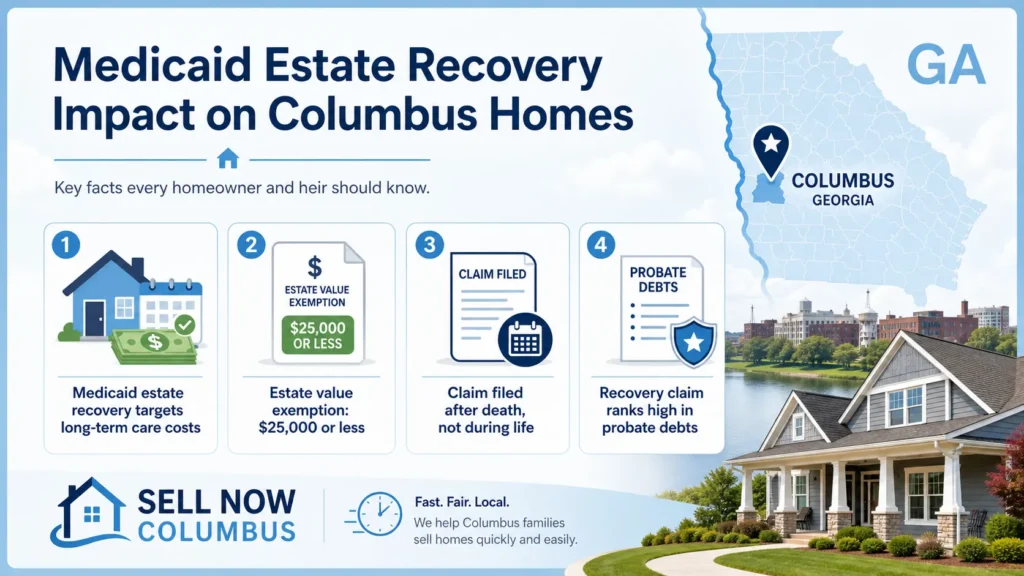
Medicaid estate recovery in Georgia lets the state seek repayment from a deceased member’s estate. It usually targets long-term care costs, such as nursing home care. The house can be involved, but a legal process and several protections apply.
This guide explains how the Medicaid estate recovery program works, what it means for your home, and which options exist. We are not lawyers, so confirm details with official rules and a Georgia elder-law attorney. Read it as a starting map, not as legal advice for your estate.
What Is Medicaid Estate Recovery in Georgia?
Georgia’s Medicaid Estate Recovery Program is a claim process that starts after a member dies. It is not a seizure while someone still lives at home. The state describes the program on its official Medicaid Estate Recovery Program page.
Federal law requires every state to run a recovery program. Georgia’s formal rules appear in Georgia Administrative Code 111-3-8. Think of the state as a creditor asking the estate for repayment.
In simple terms, the process looks like this:
- Medicaid pays certain medical and long-term care costs during the member’s life, including many nursing home and home-based care services.
- After death, the state reviews whether the member’s estate is subject to recovery under current Georgia rules.
- If recovery applies, the state sends written notice and files a claim against the estate for repayment.
- Not every Medicaid recipient’s estate faces recovery, so never assume without checking the notice.
Georgia’s rule defines estate broadly, and its text lists items beyond ordinary probate property. Confirm what counts before assuming anything about a specific account or deed. The rule also exempts estates with a gross value of $25,000 or less. Always compare any summary, including this one, against the current official wording.
A few terms appear in nearly every estate recovery letter:
• Estate: everything the member owned at death that the rules treat as recoverable.
• Personal representative: the executor or administrator who manages the estate and answers to the probate court.
• Heirs: the people who inherit under a will or Georgia’s default rules.
• Lien: a legal claim recorded against real property that must be cleared before a clean sale.
• Deferral: a pause in collection that may end when the protected person leaves the home or dies.
How Georgia Medicaid Estate Recovery Works Step by Step
Imagine you are the executor for a parent’s Columbus estate. An envelope from the recovery office arrives next to the court papers. Here is the usual sequence.
| Stage | What happens | Your move |
| Death reported | The state learns the Medicaid member has died, usually through eligibility records. | Gather the member’s Medicaid card, letters, and estate paperwork. |
| Written notice | The state notifies the known representative and heirs and states the claim amount. | Read it fully, note the contact number, and calendar every date. |
| Claim filed | The state files a claim for the full value of benefits paid. | Share it with the estate’s attorney. |
| Probate handling | The claim is treated as a high-priority creditor claim inside the probate case. | Hold off on distributing assets to heirs. |
| Payment and closing | Valid claims are paid from estate funds, often from a house sale. | Settle the claim before heirs receive anything. |
The notice may mention a lien on real property when recovery is delayed. The rule also warns that a representative who distributes assets early may face personal liability. That makes patience important. Rushing a distribution to relatives can leave you personally exposed.
Keep these habits from day one. They protect you, the estate, and the heirs who are waiting on a distribution:
- Do not hand out assets before the claim is resolved, even if relatives are pressing you.
- Keep every letter and envelope, because postmarks and dates can matter later.
- Photograph the house and list its contents now, so the estate has a clear record of condition and value.
- Ask the attorney how the claim fits probate timing and creditor notices.
- Write down every phone call with the recovery office, including the date and the name of the person you spoke with.
Can Medicaid Take Your House in Georgia?
Medicaid does not usually force a sale while the member still lives in the home. After death, the home can be reached if no protection applies. The state does not change the locks, but a sale is often how estates pay the claim. The real question is whether any protection applies to your family.
Georgia may also place a lien on a nursing home resident’s house. Under the lien rules in Georgia’s estate recovery regulations, this requires no reasonable expectation of returning home. It does not apply while certain relatives live there.
Assets most often discussed in estate recovery include:
- A house or land titled only in the member’s name, which is the classic Columbus scenario.
- Bank accounts without a named beneficiary, since these usually pass through probate.
- Vehicles and personal property titled in the deceased person’s name alone.
- Family land held solely by the deceased, including older rural parcels.
- Co-owned property, depending on how the deed passes the deceased owner’s share.
- Other items Georgia’s broad estate definition may list, which an attorney should confirm.
Do not rush to deed the house to your children. Transfers can hurt eligibility and backfire later. Review Georgia transfer tax exemptions and talk to an attorney before signing anything.
| Scenario | What to ask an attorney |
| Solo-owned Columbus home | Does it enter probate, and how does the claim apply to its value? |
| Duplex co-owned with a sibling | How does the deed pass the deceased owner’s share? |
| Rural Harris County land with several owners | Which interests flow through the estate? |
| Cabin in East Alabama | What do Alabama probate and Medicaid rules require, and who coordinates both states? |
Georgia benefits and Georgia probate property fall under Georgia rules. Alabama has its own Medicaid agency and its own recovery rules. Families with property in both states should line up attorneys licensed in each one.
Who Is Protected? Exemptions, Deferrals, and Hardship Waivers
Georgia’s rules include protections that can delay or reduce recovery. Ask about them right after a notice arrives. Do not assume a claim vanishes without written confirmation. Surviving spouses, young children, and disabled children get the most attention in the rules.
| Situation | What to ask the state |
| Surviving spouse in the home | Is recovery deferred while the spouse lives there? |
| Child under 21 | Does the child’s residence protect the home? |
| Disabled child | Does disability change the claim or lien? |
| Sibling living in the home | Does sibling protection apply, and what proof is needed? |
| Financial hardship | How do we request a hardship waiver, and what proof is required? |
| Small estate | Is the gross estate value $25,000 or less? |
Deferral is not forgiveness. A delayed claim can return later, often when the protected person leaves or dies. Get any deferral confirmed in writing, and keep the letter with the estate records.
Hardship waivers help when collection would hit a family unusually hard. A widow living on a small income in the family home is a typical example. Georgia sets its own criteria and forms, so rely on your notice and the state’s website.
Families often gather:
- Income records, such as pay stubs, benefit letters, and tax returns.
- Proof of their housing situation, including a lease or mortgage statement.
- Caregiving history, especially if a child or sibling cared for the member at home.
- Evidence of their connection to the property, such as utility bills and mail.
- Statements from relatives, caregivers, or doctors who can confirm the family’s situation.
Respond quickly, even while you are still cleaning out the house. A late response can close doors that a timely one would keep open.
Deadlines and Time Limits for Georgia Estate Recovery
No single number of days fits every estate. Your notice is the best roadmap for response dates. Do not rely on a generic online answer. Probate courts and state offices follow their own calendars.
Under Georgia DCH Rule 111-3-8-.05, the state generally waits six months after the first personal representative qualifies. The claim also ranks ahead of most other estate debts. Exceptions include year’s support, funeral costs up to $10,000, and administration expenses.
Questions to put to the estate’s attorney, ideally in your first meeting:
- How long do we have to respond to the notice, and to whom?
- Is the claim amount still growing as more Medicaid bills are processed?
- When does the creditor notice period end in this probate case?
- Can we sell the house before probate closes, and what approvals are needed?
- Are back taxes also due? Our guide on being behind on Muscogee County property taxes can help.
Waiting is risky. Utilities, taxes, and tenants keep running while the claim moves forward. Build a calendar of every date and review it with the estate’s lawyer. One missed deadline can turn a manageable claim into a costly dispute.
Planning Ahead: Legal Ways to Reduce Estate Recovery Risk
Planning works best long before care begins. Rushing a deed after someone enters a nursing home can backfire. Medicaid reviews earlier transfers when a person applies.
Medicaid.gov explains the federal framework in its estate recovery overview. This section is education only, not legal advice. Avoid hiding assets or sham transfers, which can create legal trouble.
Tools that often come up in planning conversations, each of which depends on Georgia law, timing, and the exact asset:
- Trusts set up well before Medicaid is needed, since late transfers raise eligibility problems.
- Beneficiary designations that move accounts outside probate, such as life insurance and retirement plans.
- Survivorship titling, which changes how a co-owner’s share passes at death.
- Regular reviews with an elder-law attorney, because Georgia and federal rules change over time.
- A written plan for the family home, so heirs are not forced into rushed decisions after a death.
- Selling a burdensome property early. Our guide for owners who cannot keep up with a house explains the options.
Confirm the lookback period and exceptions with official sources before moving any asset. A do-it-yourself deed can create tax, eligibility, and family conflicts. Once someone is on Medicaid, options narrow quickly. Early, calm planning protects both care choices and family stability.

Selling a Georgia House When a Medicaid Claim Is Pending
Three siblings walk through a dusty inherited Columbus bungalow. The roof is tired, the floors are soft, and nobody lives nearby. The claim letter sits on the counter.
The estate has the same choices as with any inherited house. The difference is that proceeds must cover the claim before heirs split what remains. Net proceeds matter more than the sticker price.
| Option | Upside | Trade-off |
| List with an agent after repairs | Possible higher price | Repairs, showings, commissions, holding costs |
| Sell as-is to a cash buyer | No repairs or lender delays | Lower price than a renovated sale |
| One heir buys out the others | House stays in the family | Needs financing; the claim still gets paid |
| Hold and borrow | Keeps ownership | Requires income, credit, and upkeep |
Traditional sales carry commissions, closing costs, and repair credits. See how much it costs to sell a house in Georgia before comparing offers. A fair as-is offer can land close to a listing’s net result.
Before any sale, coordinate with the estate’s attorney:
- Confirm who has legal authority to sign, such as the executor or court-appointed representative.
- Ask whether court approval of the contract is needed before you accept an offer.
- Tell the closing attorney about the claim and any liens so valid debts are paid correctly.
- Request a settlement statement that shows how each dollar of the proceeds is applied.
- Keep copies of the claim, the payoff, and the closing documents with the estate file for the court.
Selling does not erase the claim. It gets paid at closing as an estate debt. Owners across the river can read about selling a Phenix City house in poor condition.
Local cash buyers can simplify the property side of a messy estate:
- No lender approval, so older wiring, roofs, or a pending claim rarely stall the closing.
- No repair list, cleaning marathon, or open houses for out-of-town heirs.
- A closing date that can match probate and claim timing.
- Offers that price in condition, such as soft floors, sagging porches, or deferred maintenance.
- Flexibility on possession, so heirs can remove keepsakes without a rushed clean-out.
At Sell Now Columbus, we buy houses as-is in Columbus and nearby East Alabama. Estates avoid repairs, lender delays, and commissions. Reach out for a no-pressure conversation about your Georgia or East Alabama house.
FAQs: Medicaid Estate Recovery Georgia
Does Georgia do Medicaid estate recovery?
Yes. Georgia’s program can seek repayment for certain Medicaid benefits from a deceased member’s estate. Check the official state page for current guidance, and review specifics with a Georgia elder-law attorney. Families most often meet the program after long-term care.
Can you avoid Medicaid estate recovery in Georgia?
Sometimes. Some estates qualify for protections, deferrals, or hardship relief, and early planning can reduce exposure. No shortcut works for every family, so share full facts with an attorney first. Avoid internet shortcuts that rely on risky transfers.
How long does Georgia have to collect after death?
There is no single answer. Recovery runs within probate timelines, and your notice may set response dates. Treat those dates seriously and have the estate’s attorney help you calendar them. That keeps disputes and protection requests on time.
Does estate recovery apply to Columbus homes or East Alabama properties?
Georgia rules apply to Georgia Medicaid recipients and Georgia property. East Alabama property raises Alabama probate and Medicaid questions. Use attorneys licensed in each state when property crosses the river, and do not assume the rules match.
Can we sell an inherited house as-is with a claim pending?
Often, yes. The closing attorney can pay valid estate debts from proceeds before heirs receive funds. The executor and estate attorney must approve the sale and handle the closing properly. The claim still gets paid from proceeds.
Will a claim scare off a cash buyer in Columbus?
Usually not. Experienced local cash buyers handle liens, back taxes, and claims regularly. Be transparent early so the closing attorney can pay valid claims from the sale proceeds. Surprises, not claims, are what derail closings.