


You are standing in a half-cleaned-out Columbus house you just inherited. A relative slides a printed quitclaim deed across the table. They promise signing it will take care of everything.
Here is the short answer. A quitclaim deed in Georgia transfers whatever interest one person holds, but it promises nothing about clean title. It does not erase mortgages, tax liens, HOA dues, judgments, or family disputes.
This guide explains what a Georgia quitclaim deed does, how to complete and record one, and where it falls short. You will also see when selling as-is to a local cash buyer may be simpler.
• Who this helps: heirs, divorcing spouses, landlords, and owners with messy title around Columbus and East Alabama.
• What it covers: requirements, recording steps, costs, risks, and quitclaim versus warranty deed comparisons.
• What it is not: legal advice. Talk with a Georgia real estate attorney before signing any deed.
Quitclaim Deed Georgia Basics: What It Really Does
A relative hands you a free quitclaim form and says signing it makes the house yours. You wonder whether that paper truly makes you the owner. The answer depends on what the signer actually owned.
The person signing is the grantor, and the person receiving is the grantee. If the grantor owns the whole property, the whole interest passes. If they own nothing, nothing passes, even with signatures.
A quitclaim deed passes along whatever someone has, without promises. It usually does not:
- Guarantee there are no other owners or heirs.
- Guarantee freedom from mortgages, tax liens, or HOA debts.
- Promise clear title the way a warranty deed typically does.
Around Columbus, quitclaim deeds commonly show up in a few family and investor situations.
• Parent to child: a parent adds or transfers their interest in a Muscogee County rental.
• Spouse changes: one spouse is added or removed after marriage or divorce.
• LLC transfers: an owner moves a rental into an LLC they control.
Buyers and title companies still review the entire title history at sale time. A quitclaim changes the names on the deed, not the story behind them. If ownership questions remain, closings can stall.
Title companies want clear answers to a few basic questions.
- Did every necessary owner or heir sign?
- Were any ex-spouses left out?
- Was each deed recorded in the correct county?
Divorce situations often raise mortgage questions too. Our guide on taking over a mortgage during a divorce in Georgia explains why a quitclaim alone does not remove your loan obligation.
Before signing any quitclaim deed, ask yourself a few honest questions.
- Do I know exactly what interest the grantor owns today?
- Are there liens, unpaid taxes, or HOA balances attached to the property?
- Would every heir or co-owner agree with this transfer?
Georgia Quitclaim Deed Requirements and Why Details Matter
Picture yourself at the Muscogee County clerk’s counter after leaving work early. You slide your deed across the glass. The clerk says it cannot be recorded as written.
Georgia law requires a deed to be in writing, signed by the maker, and attested by an officer and one other witness. The officer is usually a notary public. Georgia’s conveyance statutes also state that no specific deed form is required.
| Requirement | What it means in practice |
| Written original document | A signed paper deed, unless filed electronically through approved systems |
| Grantor and grantee names | Names should match prior recorded deeds, including middle initials |
| Legal description | Copied from the last recorded deed, not just the street address |
| Transfer language | Clear words quitclaiming the grantor’s interest to the grantee |
| Grantor signature | Signed by the person giving up the interest |
| Officer attestation | Usually a notary public watching the signature |
| Unofficial witness | One additional witness who also signs |
Deeds are recorded with the Clerk of Superior Court where the property sits. For a Columbus house, that means Muscogee County, regardless of your mailing address.
Small mistakes create big headaches later. Common errors include:
- Leaving off a middle initial used on the prior deed.
- Copying a legal description from a tax bill instead of the recorded deed.
- Missing the witness signature or notary block entirely.
A rejected deed sends you back to square one. Worse, a recorded but flawed deed may surface years later when a title company demands a corrective deed.
- Pull the last recorded deed before filling out anything.
- Call the clerk’s office to confirm current formatting and recording rules.
- Have a Georgia closing attorney review the deed before signing.
How to Complete and Record a Quitclaim Deed in Georgia
You have printed a form and now face blank spaces for grantor, grantee, and witnesses. Mistakes could delay a sale you badly need. Here is the basic flow many Columbus owners follow.
| Step | Action | Why it matters |
| 1 | Confirm current ownership | The last recorded deed shows who must sign |
| 2 | Use a Georgia-appropriate form | Proper signature and attestation blocks avoid rejection |
| 3 | Copy the correct legal description | Prevents confusion in future title searches |
| 4 | Fill in names and transfer language | Names should match prior deeds closely |
| 5 | Sign before an officer and one witness | Meets Georgia attestation requirements |
| 6 | File the PT-61 and record the deed | Recording puts the transfer on public record |
| 7 | Keep recorded copies | Buyers and attorneys will ask for them later |
Before recording, Georgia requires a PT-61 transfer tax declaration. You can complete it through the GSCCCA PT-61 eFiling portal, then print a copy for the clerk.
The Georgia real estate transfer tax must be paid before recording when it applies. Some family transfers may qualify for exemptions. Always confirm exemption rules with the clerk before filing.
- Gifts between family members may be exempt from transfer tax.
- Transfers with no valuable consideration may still require a PT-61 filing.
- Your county clerk can answer taxability questions directly.
Our guide to Georgia transfer tax exemptions explains which transfers often qualify. If the property sits in East Alabama, Alabama deed and recording rules apply instead.
Bring a complete package to the clerk’s office to avoid a second trip.
- The original signed and attested deed.
- A printed copy of your completed PT-61 form.
- Payment for recording fees and any transfer tax due.
What a Georgia Quitclaim Deed Might Cost You Now and Later
Someone brags about saving money by preparing a quitclaim deed themselves. Weeks before closing, a title company flags that old deed. Suddenly the cheap shortcut threatens the entire sale.
Upfront costs often look manageable. The real expense usually shows up years later.
| Cost type | Examples | When it appears |
| Visible upfront | Form, notary fee, recording fee, transfer tax if applicable | At signing and recording |
| Professional help | Attorney drafting or review fees | Before signing |
| Hidden later | Corrective deeds, heir disputes, delayed closings | At sale or refinance |
| Lost value | Lower backup offers, extra holding costs | When a deal falls apart |
Recording fees change, so confirm current amounts with the Muscogee County clerk. Skipping professional help can cost far more than it saves.
• Family disputes: one sibling quitclaims the house to themselves, and other heirs object.
• Corrective deeds: errors in old language force last-minute signatures before closing.
• Holding costs: delays mean more taxes, insurance, and utility bills.
Here is a common Columbus scenario. Three siblings inherit a house, and one rushes a quitclaim deed. Years later, the title company finds missing heirs, and everyone must regroup.
Unpaid property taxes add pressure during these delays. See our guide for owners behind on Muscogee County property taxes if bills are piling up.
- Budget for attorney review before signing, not after problems appear.
- Confirm recording fees with the clerk in advance.
- Keep receipts and recorded copies together for future closings.
Risks and Disadvantages of Using a Quitclaim Deed in Georgia
A Columbus seller arrives at closing, excited to finally sell. The title company reports an old lien and a possible co-owner. The quitclaim they signed years ago fixed nothing.
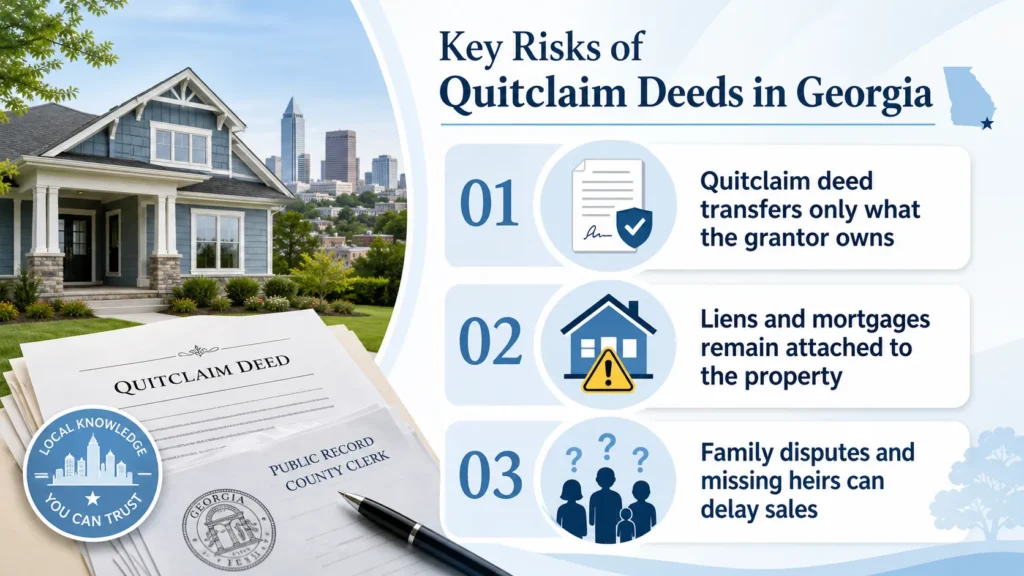
These are the main risks owners should weigh before signing.
• Limited interest: the grantee receives only what the grantor truly owned, possibly nothing.
• Liens stay attached: mortgages, tax liens, HOA dues, and judgments generally remain with the property.
• Family fallout: heirs who feel excluded may challenge the transfer.
• Cautious lenders: a chain of homemade quitclaims can trigger extra document requests.
• Weaker protection: a quitclaim offers far less title protection than a warranty deed.
Loans do not disappear when names change. If your property carries a second mortgage, our guide on selling a house with a HELOC in Georgia explains how payoffs work at closing.

Houses passed back and forth within families often hide unresolved interests. When a buyer finally makes an offer, the closing attorney may uncover missing signatures.
- Gather every deed you can find before listing.
- Ask relatives whether anyone else signed or held interest.
- Let a closing attorney trace the full chain of title.
Watch for warning signs when someone pushes you to sign quickly. A reputable buyer explains every document and involves a closing attorney.
- Pressure to sign in a parking lot or without review.
- Refusal to explain why a quitclaim is being used.
- No title company or attorney involved in the transaction.
Quitclaim Deed vs. Warranty Deed in Georgia
You may wonder whether you need a quitclaim deed or a regular deed to sell. The answer depends on who is transferring and why. This comparison offers general guidance only.
| Deed type | Typical use | Buyer protection | Columbus example |
| Quitclaim deed | Family transfers, co-owners, LLC moves | Little to none | Parent adding a child to a rental title |
| General warranty deed | Standard sales, often with lenders | Strongest assurances of good title | Financed sale to an owner-occupant |
| Special warranty deed | Investor and some bank-owned sales | Covers only the seller’s ownership period | Investor selling a short-term hold |
The Georgia Department of Revenue’s deed fundamentals guide outlines these common deed types. Georgia deeds generally carry warranties only when the deed expressly states them.
- Quitclaims often appear early, when families sort out ownership.
- Warranty deeds usually appear at the final sale to a buyer.
- Most serious Columbus cash buyers close with a warranty deed after a title search.
Investors also use quitclaims as tools, not final answers. A responsible buyer runs a full title search and closes through a Georgia attorney.
- Moving rentals into an LLC the owner controls.
- Buying out a co-owner’s share before a sale.
- Clearing a small leftover interest held by a relative.
Properties across the river follow Alabama law and Alabama deed practices. Owners with houses on both sides should keep separate paperwork and use state-specific attorneys.
When a Quitclaim Deed Is Not Enough: Selling As-Is in Columbus
You sit at the kitchen table surrounded by IRS notices and mortgage warnings. Someone suggests a quitclaim deed as a quick fix. In serious situations, it usually just moves paper around.
These situations typically need more than a simple quitclaim form.
• Tax or judgment liens: liens usually stay tied to the property, not the name.
• Probate disputes: multiple heirs may need court orders or formal estate work.
• Unclear divorce terms: a quitclaim may conflict with what a judge would order.
• Dodging creditors: transfers made to avoid creditors or foreclosure can be challenged.
If you face liens, probate fights, or foreclosure pressure, consult a Georgia attorney promptly. An article cannot replace advice tailored to your facts.
- A Georgia real estate attorney for deed, lien, and title questions.
- A probate attorney when heirs disagree or an estate remains open.
- Your divorce attorney when property terms in a decree are unclear.
Many Columbus owners choose another path and sell as-is to a local cash buyer. The buyer’s closing attorney handles deed preparation, title review, and recording.
• No lender approval: more flexibility in solving title issues.
• Local experience: familiarity with older Columbus homes and messy paper trails.
• As-is pricing: repairs and title work are built into the offer.
• Attorney-handled paperwork: you avoid guessing whether old quitclaims were done right.
Before deciding, compare the full costs of each path. Our breakdown of the cost of selling a house in Georgia shows how commissions and repairs add up.
When you contact a cash buyer, share what you know upfront. Honesty helps the closing attorney resolve issues faster.
- Copies of any deeds, including old quitclaims.
- Mortgage, lien, or tax statements you have received.
- Names of heirs, co-owners, or ex-spouses with possible interests.
FAQs: Georgia Quitclaim Deeds
Do I need a Georgia attorney to file a quitclaim deed?
Not always, but it is wise. A Georgia real estate attorney ensures the deed language, attestation, and recording steps meet state law. Attorney help matters most with liens, probate, or divorce.
Can a quitclaim deed fix a broken chain of title?
Usually not by itself. Chain-of-title repairs often require a full title search and corrective documents prepared by a closing attorney. If a title company flags an issue, get professional help.
Is a quitclaim deed the same as a security deed in Georgia?
No. A quitclaim deed transfers ownership interest, while a security deed secures a loan against the property. Signing a quitclaim does not remove or pay off any existing security deed.
What witnesses does a Georgia quitclaim deed need?
Georgia requires the deed to be attested by an officer, usually a notary public, and one other witness. Both watch the grantor sign and then sign the deed themselves.
Can I sell my Columbus house as-is with an old quitclaim in the chain?
Yes, in many cases. The buyer’s title company will review older deeds and may request extra documents. Experienced local cash buyers often coordinate corrective deeds through their closing attorney.
Will quitclaim deed issues scare off a cash buyer?
Not usually. Experienced Columbus cash buyers regularly handle inherited houses and messy title. They price risks into the offer and work with attorneys to resolve problems before closing.
A quitclaim deed can move an interest between people, but it rarely fixes liens, broken title, or family disputes. If old deeds, probate, or lien letters overwhelm you, Sell Now Columbus can make a simple as-is offer. A Georgia closing attorney handles the paperwork so you can move on.