


Losing a house at foreclosure in Georgia does not always erase the debt behind it. And being in receipt of a foreclosure notice means, the bank could sue you. If the auction price falls short of your loan balance, that gap is called a deficiency, and it can turn into a deficiency judgment against you personally.
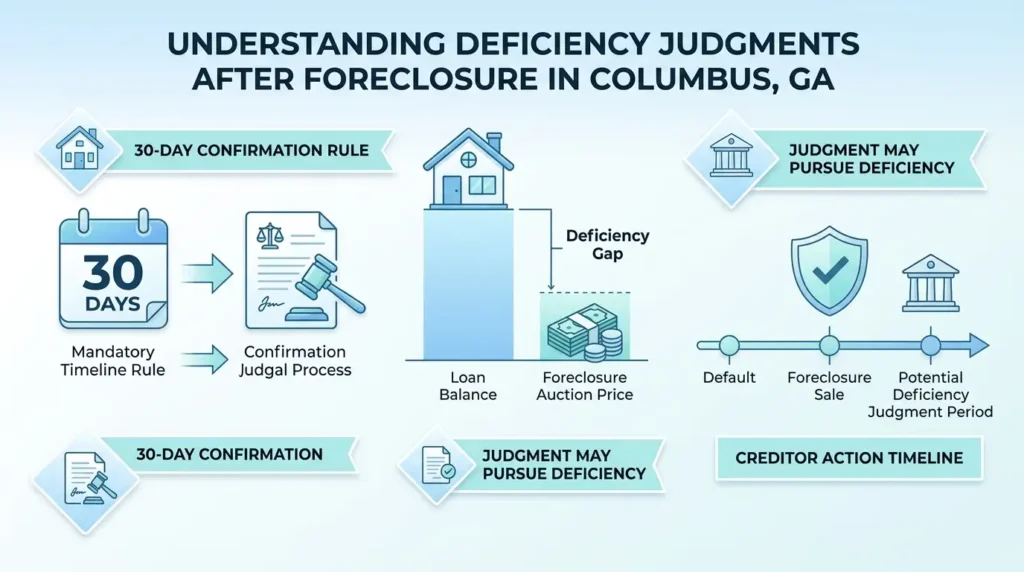
In Georgia, a lender can only pursue a deficiency judgment after foreclosure if they report the sale and get it confirmed by a judge within 30 days, per the Georgia Attorney General’s foreclosure information. Miss that window, and they are generally barred from collecting the leftover balance.
That 30-day window is the single most important date to understand if you’re worried about being sued after losing your home.
We are based in Columbus and hear this fear constantly from homeowners across Muscogee County and East Alabama. Our blog breaks down how Georgia’s foreclosure and deficiency rules work, what happens after the sale, and the real options you have before the auction ever happens.
We’ll walk through the 30-day confirmation rule, what a typical Georgia foreclosure timeline looks like, and how selling before the sale date can remove deficiency risk from the equation entirely.
This isn’t legal advice — talk with a Georgia attorney or housing counselor about your specific situation. By the time you finish this guide, you should have a clear, practical sense of what a deficiency judgment means for your household.
What Is a Deficiency Judgment After Foreclosure in Georgia?
A deficiency is simply the gap between what you owed and what the house brought at the foreclosure sale. A deficiency judgment is the court order that lets your lender chase that gap from you personally. The two are not the same thing, and the difference matters.
| Term | What It Means |
| Deficiency balance | The unpaid gap left on the lender’s books after the sale |
| Deficiency judgment | A court-approved order making you personally liable for that gap |
Say your Columbus home carries a $220,000 balance, and the courthouse auction brings only $180,000. That $40,000 gap becomes a deficiency judgment only if the lender goes to court and wins confirmation under OCGA 44-14-161. Foreclosure decides who owns the house; confirmation decides whether the lender can come after you.
That distinction trips up a lot of homeowners, since the foreclosure itself feels like the end of the story. In Georgia, it’s really just the first of two separate legal steps.
Deficiency risk runs highest on older or inherited homes where auction buyers expect steep discounts. Selling before foreclosure to a local cash buyer who pays off the loan removes that leftover gap entirely. For the full sale-to-auction timeline, see our Columbus GA foreclosure process timeline.
A lot of homeowners assume the debt vanishes once the house is gone. In reality, the auction sets the size of the gap, and Georgia’s confirmation process decides whether the lender can legally pursue it.
This confirmation step exists specifically to protect borrowers from an unfairly low sale price being used to inflate a deficiency claim. A judge has to be satisfied the price reflected true market value before any deficiency judgment can move forward.
How and When a Georgia Lender Can Pursue a Deficiency Judgment
Georgia is a non-judicial foreclosure state, so lenders typically do not sue to foreclose. But to chase you for a deficiency, they must go to court and follow a strict timeline.
• Petition filed within 30 days after the sale, under OCGA 44-14-161
• Confirmation hearing checks proper notice, advertising, and fair market value
• No timely confirmation generally means no deficiency judgment on that sale
• Complex situations — multiple loans, commercial property, or prior bankruptcy — can change how these rules apply
Once the sale closes, possession and the deficiency question move on separate tracks. The new owner can pursue a dispossessory action if you have not moved out, while the lender separately decides whether to seek confirmation. Some buyers offer cash-for-keys instead of court action.
Watch your mail closely during that 30-day window, since silence does not guarantee a lender will skip confirmation. Selling before the sale date avoids both the eviction process and the deficiency question. Learn more about how Sell Now Columbus helps stop foreclosure.
If you’re still living in the home when it sells, the new owner can offer cash for keys as an alternative to a court filing. That usually means a set move-out date and a small cash payment in exchange for leaving the property broom-swept.
Eviction and deficiency are two separate issues that sometimes get confused. Eviction is about who has the legal right to occupy the property, while deficiency and confirmation are strictly about money owed after the sale.
Quick Overview: How Foreclosure Works in Georgia
Georgia foreclosures follow a defined, non-judicial path built around a power-of-sale clause in your deed. Knowing the steps helps you see exactly where the deficiency question fits in. S
| Step | What Happens |
| Default | Missed payments or another loan default trigger the process |
| 30-day notice | Written notice required under OCGA 44-14-162.2, with a modification contact |
| Advertising | Sale advertised in the county legal newspaper for four weeks |
| Courthouse sale | Auction typically held the first Tuesday of the month |
The auction price on that first Tuesday decides whether a deficiency gap even exists. Compare it against your loan balance plus fees to see the size of the risk. For every notice and date in detail, see our Columbus GA foreclosure process timeline.
The one thing you still control is whether the house ever reaches that auction. Selling before the sale date, often to a cash buyer, can settle the loan and remove the deficiency math altogether.
Because Georgia’s timeline moves fast once a notice goes out, homeowners who act in the first few weeks generally have more options than those who wait until the week of the sale.
Georgia does allow judicial foreclosure in rare cases, but nearly every residential mortgage foreclosure here follows the faster, non-judicial path described above. That’s part of why the process can feel so quick once it starts.
Options to Avoid or Reduce Deficiency Risk
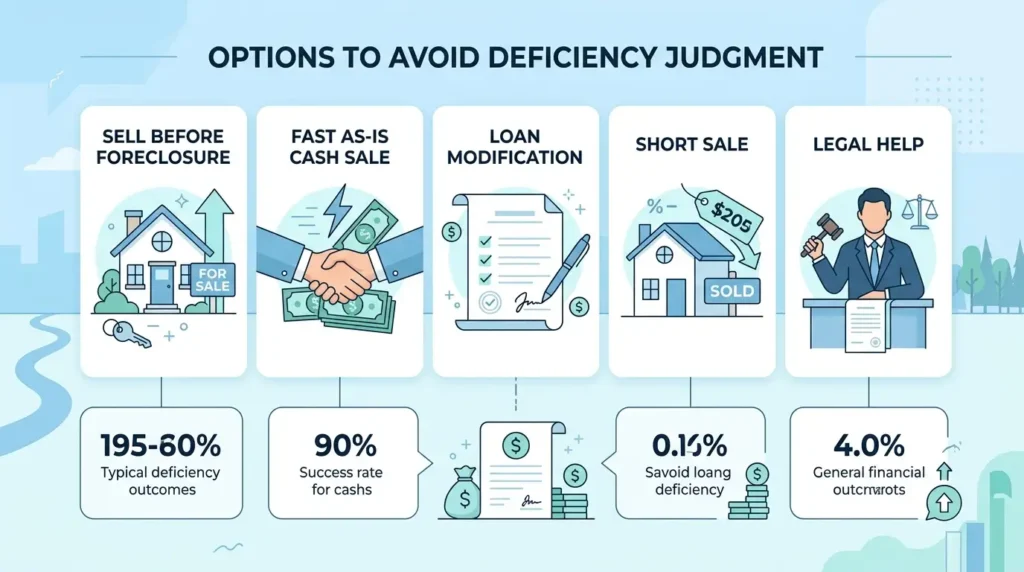
You have real choices both before and after foreclosure that can lower or resolve deficiency risk. The right one depends on your equity, timeline, and how much cash you have available.
| Option | Best For |
| Sell before foreclosure | Homeowners who want a clean payoff and no lingering risk |
| Fast as-is cash sale | Tight timelines, repairs needed, or inherited property |
| List with an agent | Solid equity and enough time before the sale date |
| Loan modification | Keeping the house if payments can be restructured |
| Short sale or deed in lieu | Underwater loans where the lender may accept less |
• Call your lender as soon as you miss a payment — many have loss-mitigation teams that can discuss options before a notice ever goes out
• Ask specifically whether a program waives any deficiency, since not all modification or short-sale offers include that protection
A short sale or deed in lieu still needs written clarity from the lender on whether any deficiency is waived. Bankruptcy is a serious step that can affect both foreclosure and a deficiency judgment, and only a Georgia attorney can advise on that path.
A deed in lieu can move faster than a short sale since there’s no buyer to find, but lenders don’t always accept one, especially if the property has other liens attached.
The highest offer does not always leave you with the most money. Once you subtract repairs, commissions, and months of payments, a fast as-is cash sale can sometimes net more. Read more about how to sell a foreclosure house in Georgia.
Whatever option you lean toward, gather your loan documents, track every notice you receive, and write down questions for a housing counselor or attorney. Showing up prepared tends to open up better outcomes, especially under a tight timeline.
How a Deficiency Judgment Affects Your Wages, Credit, and Columbus Homeowners
A confirmed deficiency judgment is a separate court order making you personally liable for the balance. At that point, the lender can pursue wage garnishment, bank account levies, or liens on other property you own.
The debt does not disappear quickly, either. A deficiency claim tied to the mortgage note generally falls under the six-year statute of limitations for written contracts under OCGA 9-3-24. Once entered, a judgment is typically enforceable for up to seven years, with possible revival under OCGA 9-12-60.
Once a judgment exists, it can also attach to other property you own, not just future wages. That’s part of why so many homeowners work hard to resolve or avoid a deficiency before it ever reaches that stage.
A confirmed judgment can also complicate future plans, from qualifying for a new mortgage to co-signing for a family member, since it remains a visible, collectible debt for years.
The rules are statewide, but the experience is local: sales happen on the Muscogee County courthouse steps, and local judges and attorneys handle confirmation. We regularly hear from Columbus and Phenix City homeowners worried about being chased after the house is gone.
Acting early is almost always easier than fighting a judgment years later. That might mean selling before the sale date, negotiating with the lender, or talking with a Georgia attorney about your options.
Common Columbus situations we see include inherited houses that need major updates, long-term rentals with deferred repairs, and military families juggling PCS orders alongside missed payments in the same season.
Whatever your situation looks like, the fear is usually the same: if the house sells too low at auction, could the bank still come after you personally? Understanding the confirmation rule is the first step toward answering that for your own case.
Key Georgia Laws and Resources
You do not need to memorize statute numbers, but knowing where the rules live helps you ask better questions. These are the core Georgia laws that shape deficiency judgments.
| Law | What It Covers |
| OCGA 44-14-161 | Confirmation requirement before a deficiency judgment |
| OCGA 44-14-162.2 | 30-day pre-sale written notice |
| OCGA 9-3-24 | Six-year limit on written-contract claims |
| OCGA 9-12-60 | Judgment dormancy and revival after seven years |
For consumer-friendly guidance on foreclosure basics and scam warnings, the Georgia Attorney General’s foreclosure information page is a strong starting point. Bring printouts of the relevant sections to a Georgia attorney or HUD-approved housing counselor.
We are not a law firm, but we build our process around these rules. Keep our local resources page handy as a hub for finding legal and housing help nearby.
Printing or screenshotting the relevant code sections before meeting with an attorney or housing counselor can make that conversation far more focused and productive, especially if your timeline is short.
National legal sites can offer helpful background, but these Georgia code sections and the Attorney General’s office are what local courts and lenders actually follow day to day.
Which Path Is Right for You: Lawyer, Bankruptcy, or a Cash Sale
Sometimes the house is not the only problem — years of arrears or other debts may call for a Georgia bankruptcy or real estate attorney. Selling can still be part of that plan even when courts are involved.
• Talk to an attorney if the sale price seemed unfair, a confirmation hearing is scheduled, or bankruptcy is on the table
• Chapter 13 may pause a sale through the automatic stay while a repayment plan is worked out
• A trustee or court can approve a sale to a cash buyer as part of a larger repayment plan
A local cash buyer can make the property side simple regardless of which path you take. We use our own funds, buy homes as-is, and factor repairs into the offer upfront so nothing slows down closing.
This matters most when a court-approved sale needs to happen on a fixed schedule. A buyer who can close quickly and without financing contingencies gives your attorney or trustee one less variable to manage.
By stepping in before the auction, a fast cash sale can pay off the loan, avoid a low auction price, and skip the eviction process altogether. Read more about selling a house in bankruptcy in Georgia if that applies to you.
There’s nothing wrong with pursuing a legal strategy and a cash offer at the same time. Having a no-pressure number in hand can make it easier to decide what fits your bigger financial picture.
Whichever route you choose, keep your attorney or trustee informed of any offer before you sign anything, especially if a bankruptcy case is already open.
FAQ: Deficiency Judgments After Foreclosure in Georgia
What is a deficiency judgment after foreclosure in Georgia?
It’s a court order making you personally responsible for the gap between your loan balance and the foreclosure sale price. It only applies if the lender wins court confirmation under OCGA 44-14-161.
Can a lender pursue a deficiency judgment after a foreclosure in Georgia?
Yes, but only if they report the sale and get court confirmation within 30 days. Missing that window generally bars them from pursuing a deficiency judgment tied to that particular non-judicial foreclosure sale.
How long can a deficiency judgment stay on my record?
A deficiency claim generally falls under Georgia’s six-year statute of limitations for written contracts. Once entered, a judgment is typically enforceable for up to seven years, with possible revival under OCGA 9-12-60.
What options do I have to avoid deficiency risk before foreclosure?
You can sell before the auction, often to a cash buyer, ask your lender about a modification, repayment plan, or short sale, or talk with a Georgia foreclosure attorney about your specific situation and options.
Can I sell my Georgia house as-is to avoid a deficiency judgment?
Often yes — a cash buyer can close before the auction and send the payoff directly to your lender, though you should still confirm the exact payoff amount and terms with your lender first.
Do I need to fix anything before selling if I’m already in foreclosure?
No. Sell Now Columbus buys houses in any condition and factors needed repairs into the offer, so you are not asked to spend money on a house you’re trying to leave behind.
Where can I find official guidance on foreclosure and deficiency in Georgia?
Start with the Georgia Attorney General’s foreclosure information page, then review Georgia code sections on trusted legal sites like Justia, and discuss how they apply with a Georgia attorney or housing counselor.
Ready to Talk Through Your Options?
Foreclosure and deficiency judgments can feel like a maze, especially while you’re worried about keeping a roof over your family’s head. Acting early and understanding Georgia’s 30-day confirmation rule can change the outcome significantly.
Whether you end up selling, negotiating a modification, or working with an attorney, the goal is the same: know your numbers, know your deadlines, and make the decision that protects your finances longest-term.
If you are in Columbus, GA or nearby in East Alabama and would rather solve this before it becomes a foreclosure and possible deficiency judgment, we are here as a local option. With Sell Now Columbus, you can sell as-is, skip repairs and commissions, and set a move-out date that fits your life.
You avoid the shock of an unknown auction outcome and the uncertainty of a possible lawsuit later. We handle the details; you pick the closing date that works for your family.
If you’re not sure which option fits, that’s normal — most homeowners in this position are weighing a legal question and a property question at the same time, and it helps to get guidance on both.
Reach out to Sell Now Columbus about stopping foreclosure and see whether a fair cash offer makes sense for your home.